
Hart County Court Calendars Explained
Start with the Hart County Clerk of Superior Court calendar page. That site links to a 2026 Superior Court Calendar. The file is a 12-page scanned PDF. It is not a live docket grid. There is no name box, case-number field, date filter, court selector, pagination, or export button. You read the scan with your own eyes. Then you must verify that a listed setting still controls.
Hart County posts no separate public daily calendar. None covers civil, criminal, jury, motion, Probate, Magistrate, Juvenile, or municipal matters. One annual scan cannot serve as a complete Hart County court calendar. Probate handles its own matters. Magistrate keeps its own docket. Every municipal court sets city traffic and ordinance dates itself. The notice issued in your case still carries real weight.
Hart Calendar PDF Limits
A scanned calendar wears the costume of a web record but never acts like one. Browser text search may miss a date. The PDF lacks a usable text layer. There is also no proof that later resets were penciled in. Open each page, find your week, and compare it against the newest notice or order. A missing name is not proof of no hearing.
The Digital Library of Georgia courthouse record documents the courthouse building. That building anchors Hart County's calendar history.
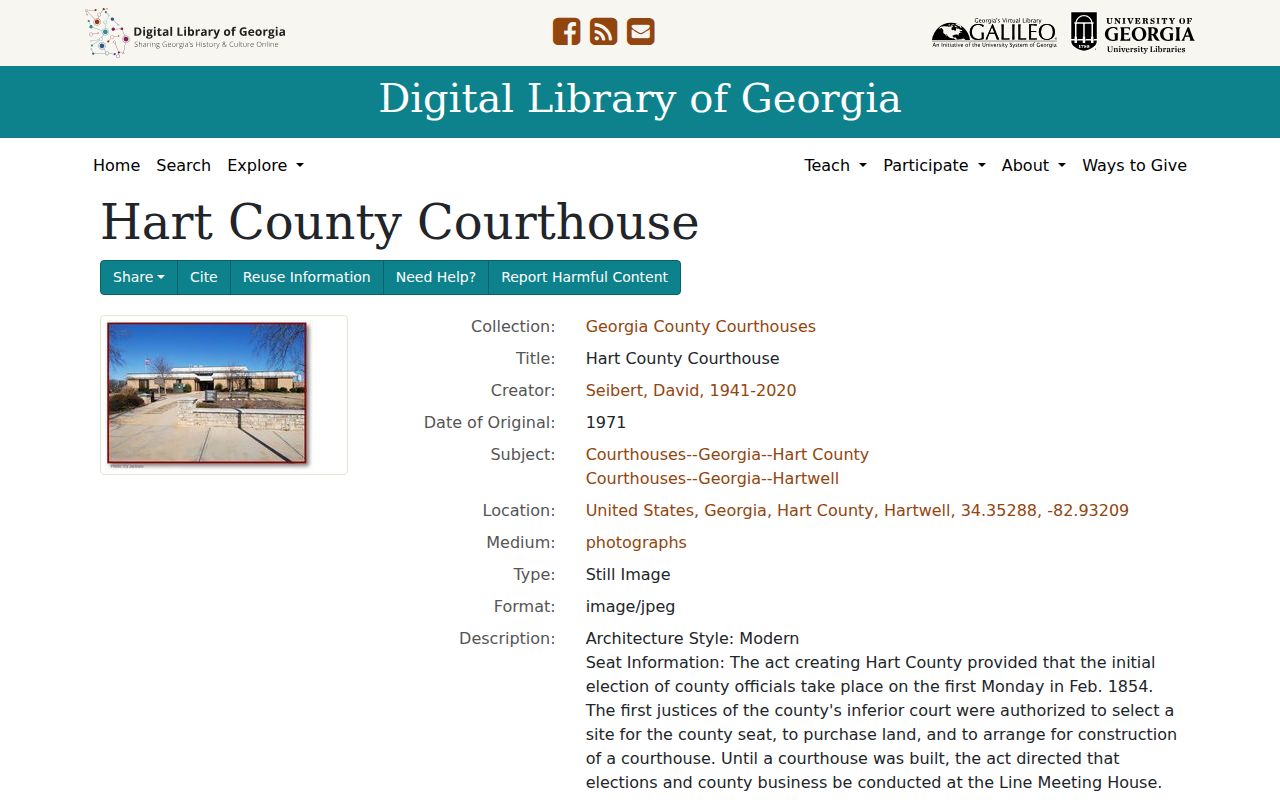
That courthouse record gives useful background. A current Hart County court date, though, may sit at another site under a later order.
Finding Your Court Date
Use every channel when the setting truly matters. Hart County publishes an annual Superior calendar, yet no single public tool covers every local court docket. When you ask about a date, name the court, the year, any case or citation number, and the event type. Keep your written notice close while you call.
- Read the summons, citation, notice, or order for the court, date, time, location, and case number.
- For Superior Court, review the Clerk calendar and current PDF. Check Georgia emergency judicial orders for Northern Circuit or Hart changes.
- Call the proper office if unclear. Superior Clerk is 706-376-7189, circuit scheduling is 706-376-7151, Magistrate is 706-376-6817, and Probate is 706-376-2565.
- For a city ticket, use the issuing city. Hartwell, Royston, Canon, and Bowersville have separate routes.
- Ask counsel about the setting when represented. Counsel may have received a later order.
- Confirm shortly before travel because a signed order, reset, cancellation, or facility move may supersede the PDF.
In person still counts. The Superior Clerk and Probate Court both sit at 185 West Franklin Street in Hartwell, while Magistrate Court sits on the courthouse square. A posted daily sheet may help, though Hart County does not guarantee one for every docket. Call before you count on a counter posting.
Hart County's 2026 Court Moves
Check the location itself in 2026. Meeting minutes dated February 5, 2026 moved Hart County Superior Court trials to the Hart County School System AgroSciences Center, and the same resolution sent Grand Jury activities to the lower Hart County Library. The official relocation minutes list no end date and never claim that every setting moved.
Confirm the venue. A Hart County court calendar date does not settle the building. Match the event type to the newest order, then call the Clerk or circuit contact.
A trial setting, a Grand Jury session, and a clerk visit are different errands. So is a routine hearing. The Clerk still keeps the Superior record even when a proceeding happens elsewhere. A case can sit in Superior Court. Do not head to the temporary trial site just because of that label. Ask whether the move covers your exact event.
How to Read a Court Setting
A setting is a scheduled court event, not necessarily a trial. Hart sources document Superior Court calendars, jury trial weeks, trials, and Grand Jury activities, but local pages publish no glossary of arraignment, motion, status, sentencing, reset, or dismissal codes. Read the notice. Confirm any shorthand you do not recognize.
| Date | The assigned day; check for a newer order. |
|---|---|
| Time | The appearance time or docket call, not an estimated trial start. |
| Courtroom | The room or facility, subject to the 2026 move and later orders. |
| Judge | The judicial officer or court assignment. |
| Setting Type | The event purpose, such as a jury trial week or Grand Jury activity. |
Keep the case number and court name next to the setting. The exact Hart state case-number format stays hidden behind the login-gated portal. If the notice and the calendar disagree, the latest signed order plus a direct call wins.
Hart Court Date Sources
Different records answer different questions. The annual calendar sketches broad plans, a case docket may show a later hearing entry, and a signed order can move or cancel a setting. For current information, call the Clerk or the circuit office.
| Source | Best Use | Limit |
|---|---|---|
| Signed order or notice | Specific case direction | Check for a newer order |
| Superior calendar PDF | Annual jury and trial planning | Static scan, no live search |
| Latest docket entry | Recent setting history | Icon is login-gated |
| Clerk or circuit call | Current confirmation | Have identifiers ready |
| Courthouse posting | Day-of information | Scope is unpublished |
Hart County's official sources offer no remote-hearing links, coordinator details, reminder texts, or permanent Zoom policy. Do not assume an in-person or remote format. Ask the court.
Continuances, Resets, and Cancellations
A continuance postpones a setting. A reset hands it a new date. A cancellation removes the event without dismissing the case. Hart County publishes no local code list, and the annual PDF is never real time. Find the written order, compare current calendar material, and call the proper office. A public 2021 Hart cancellation order cancelled specified jury weeks and directed rescheduling. Winter weather materials and the 2026 facility resolution show the same lesson. Emergencies can alter places, deadlines, and settings. Neither supports a blanket assumption that later dates moved too.
Never read a vanished calendar line as a dismissal. A payment vendor may show ticket status. The full municipal docket stays out of view. Keep each new notice, and jot down whom you contacted.
Hart Municipal Court Dates
Each Hartwell-area city runs its own municipal court dates. Hartwell City Hall, the City Clerk, or the Police Department handles what the city publishes. That means no online docket and no payment form. Royston collects payments through Government Window, but that screen is not a full docket. Canon points citations to JusticeONE. Bowersville simply lists Town Hall contact information in place of a court calendar.
The Georgia traffic locator can point you toward a vendor or court. Georgia itself says no statewide traffic database exists. Have your city and citation number ready before you call. Paying online is not the same as clearing a required appearance. It does not cure a setting you already missed. For the separate city routes, see Hart County Traffic Tickets.
When Hart Date Sources Conflict
When sources disagree, work down a chain of authority. Start with the newest signed order or summons. Then the Clerk's current calendar or posted notice, the latest docket setting an authorized user can see, and a phone confirmation. The courthouse counter or day sheet comes last. Write down the date and time of any call. A generic yearly schedule should never beat direction tied to your own case.
Three Superior Court judges cover Elbert, Franklin, Hart, Madison, and Oglethorpe counties in the Northern Judicial Circuit. Shared schedules like that make a quick confirmation worthwhile around jury weeks, storms, and temporary venues. Trust whatever source sits closest to the individual case.
If You Miss a Court Setting
Call the court named on the notice right away. Give the clerk your case or citation number. Add the missed date and the type of matter. If you have a lawyer, reach out to counsel first. Ask what the docket shows now. Ask whether a new order, warrant, bond action, or date has been entered. Do not route a city citation through Superior Court. The city itself must confirm any transfer.
Missed a setting? A failure to appear may lead to serious court action, but Hart County has no single published rule for every court and case type.
Call the correct clerk immediately and follow the court's instructions.
Seek advice from a Georgia-licensed attorney when a warrant, bond issue, or mandatory appearance may be involved.
Missed a ticket date? Call the city that issued it. For Probate, Magistrate, or Superior Court, dial that court's direct number instead, since a quick call beats any stale calendar entry.